
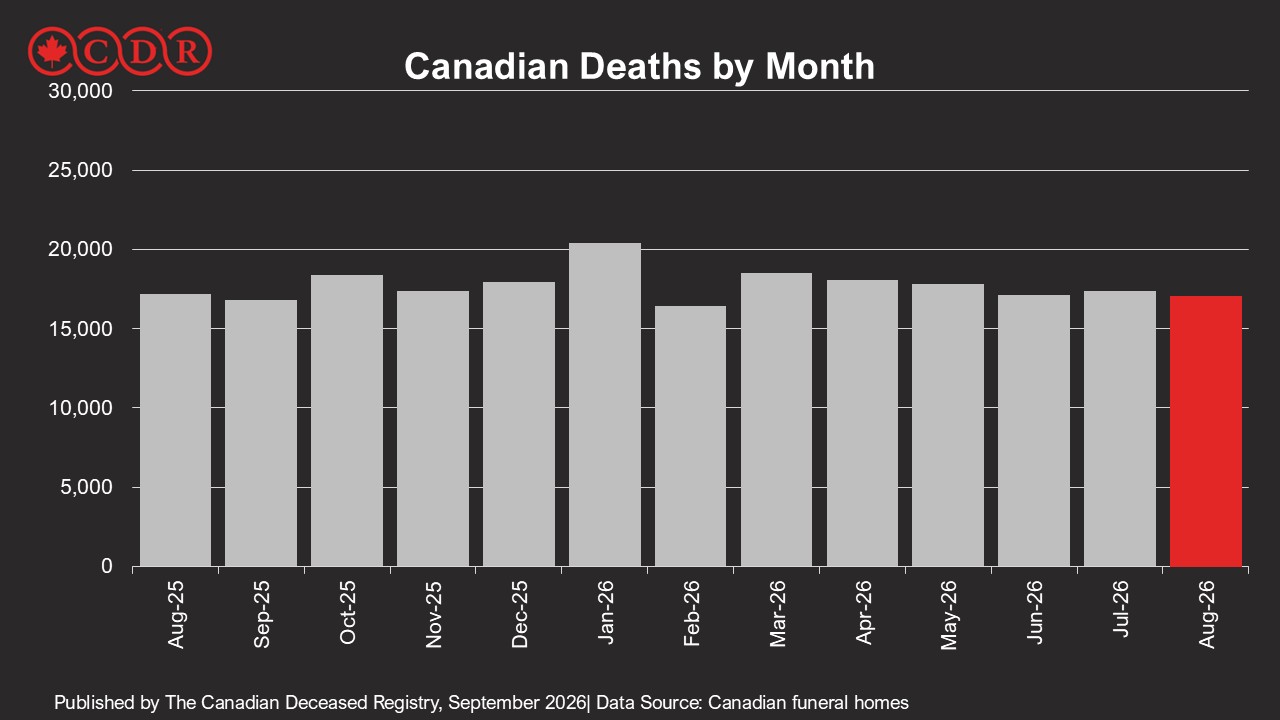
The Canadian Deceased Registry™ captured 16,933 deaths across Canada in August 2026, down from 17,378 in July, representing a 2.6% month-over-month decrease as national mortality levels remained relatively stable through the summer.
August mortality remained well below the higher levels recorded during the winter months, continuing the broader seasonal pattern of lower mortality activity following the beginning of the year.
Mortality Levels Remain Stable Through the Summer
National mortality activity has remained relatively consistent throughout the late spring and summer months:
- August 2026: 16,933
- July 2026: 17,378
- June 2026: 17,150
- May 2026: 17,817
- April 2026: 18,080
- March 2026: 18,492
- February 2026: 16,434
- January 2026: 20,432
August’s total was approximately 17% below January’s seasonal high, while remaining broadly consistent with the mortality levels recorded during recent summer months.
Compared with August 2025, when 17,181 deaths were captured, August 2026 was approximately 1.4% lower year over year, indicating relatively stable mortality activity compared with the same period last year.
Ontario and Quebec Continue to Drive National Totals
Canada’s largest provinces continued to account for the majority of deaths captured nationally during August:
- Ontario: 6,407
- Quebec: 4,576
- Alberta: 1,402
- British Columbia: 1,295
Ontario represented approximately 37.8% of all deaths captured nationally in August, maintaining its position as the largest contributor to national mortality totals.
Together, Ontario and Quebec accounted for approximately 65% of all deaths captured during the month, reinforcing the importance of comprehensive deceased identification coverage across Canada’s largest population centres.
Provincial Mortality Trends Were Mixed in August
While national mortality declined modestly, provincial results varied across the country.
Notable month-over-month changes included:
- Newfoundland and Labrador: 322 → 380 (+18.0%)
- New Brunswick: 665 → 692 (+4.1%)
- Manitoba: 736 → 758 (+3.0%)
- Quebec: 4,485 → 4,576 (+2.0%)
- Ontario: 6,751 → 6,407 (-5.1%)
- Alberta: 1,518 → 1,402 (-7.6%)
- British Columbia: 1,404 → 1,295 (-7.8%)
- Nova Scotia: 701 → 639 (-8.8%)
Prince Edward Island remained unchanged at 114 deaths, while Saskatchewan declined slightly from 682 to 670.
Overall, the provincial movements were mixed, with declines across several larger provinces contributing to the modest national decrease.
What This Means for Data, Risk, and Compliance Teams
Mortality data isn’t just demographic — it’s operational.
Accurate and timely deceased identification remains essential for organizations looking to:
- Prevent fraud and overpayments
- Maintain regulatory compliance
- Protect brand reputation
- Improve database integrity
- Reduce returned mail and unnecessary outreach
- Prevent inappropriate communications with deceased customers
Even during periods of relatively stable mortality activity, customer and constituent databases continue to change every month.
For organizations managing large consumer databases, insurance records, financial accounts, loyalty programs, fundraising files, or other customer information, regular deceased screening helps ensure records remain accurate and actionable.
Access to a national Canada-wide mortality database of deceased Canadians who have passed away can help organizations identify deceased individuals more efficiently and reduce the operational risks associated with outdated customer records.
Why Continuous Deceased Screening Matters
August alone added nearly 17,000 deceased records to the Canadian Deceased Registry™.
Over time, even relatively stable monthly mortality volumes can create significant data-quality issues for organizations that do not regularly update their records.
Continuous deceased screening can help organizations:
- Identify deceased individuals sooner
- Suppress inappropriate marketing communications
- Reduce unnecessary mailing and servicing costs
- Support fraud prevention and identity verification processes
- Maintain more accurate customer and prospect databases
For organizations with millions of customer records, even a small percentage of outdated records can create unnecessary costs and operational risk.
Bottom Line
The Canadian Deceased Registry™ captured 16,933 deaths in August 2026, representing a 2.6% decrease from July.
Mortality levels remained relatively stable compared with recent summer months and were approximately 1.4% lower than August 2025.
While several larger provinces recorded declines, Quebec, Manitoba, New Brunswick, and Newfoundland and Labrador experienced month-over-month increases.
For organizations that rely on accurate consumer information, these monthly changes reinforce the importance of maintaining access to a national Canada-wide mortality database of deceased Canadians who have passed away to support fraud prevention, compliance, customer data accuracy, and responsible communications throughout the year.
About The Data
The data presented in this report was summarized by the Canadian Deceased Registry™, Canada’s only national registry of deceased Canadians. To learn more about the database, submit your inquiry using our contact web form.
Distribution of the Canadian Deceased Registry™ is managed by Cleanlist, Canada’s largest customer data company. Through Cleanlist, you can license the Canadian Deceased Registry™ database or access it to clean, validate, and enrich the data you have.
