
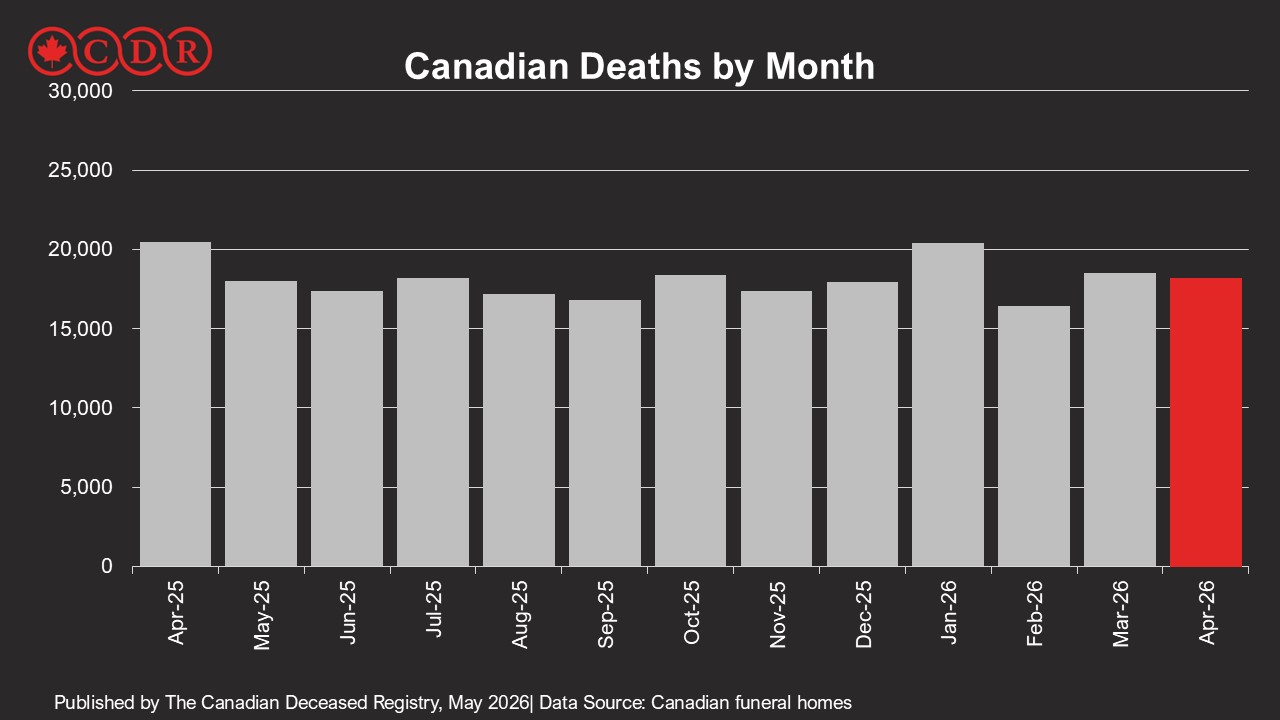
Canada recorded 18,080 deaths in April 2026, a slight decrease from 18,492 in March, representing a -2.2% month-over-month decline as mortality levels begin to stabilize following late-winter fluctuations.
While March showed a rebound from February’s low, April signals a return toward more typical seasonal baselines.
Seasonal Patterns Continue to Hold
Mortality trends remain consistent with expected seasonal cycles:
- January 2026: 20,432
- February 2026: 16,434
- March 2026: 18,492
- April 2026: 18,080
After February’s trough and March’s rebound, April reflects gradual normalization as winter-related mortality pressures ease.
Ontario and Quebec Continue to Drive National Totals
The largest provinces continue to account for the majority of deaths:
- Ontario: 6,802
- Quebec: 5,025
- British Columbia: 1,480
- Alberta: 1,512
Ontario represents approximately 37.6% of total deaths, maintaining its dominant share of national mortality and reinforcing its importance in data accuracy and compliance strategies.
March Spike Moderates Across Most Provinces
Following March’s broad-based increase across provinces, April shows moderate pullbacks in most regions, including:
- Ontario: 7,054 → 6,802
- British Columbia: 2,098 → 1,480
- Alberta: 1,572 → 1,512
This pattern suggests March’s uptick was largely seasonal rather than structural, with no sustained upward pressure into April.
Average Age at Death Remains Elevated
The national average age at death reached 78.9 years in April 2026, slightly down from 79.0 in March, but still near historic highs:
- March 2026: 79.0
- April 2026: 78.9
This continues to reflect a sustained trend toward higher life expectancy across Canada.
Several provinces continue to exceed or approach the 80-year mark:
- Quebec: 80.9
- British Columbia: 80.0
Despite minor month-over-month fluctuations, the overall age profile of mortality remains elevated, reinforcing long-term demographic shifts toward an aging population.
What This Means for Data, Risk, and Compliance Teams
Mortality data isn’t just demographic—it’s operational.
Accurate and timely deceased identification is critical for:
- Preventing fraud and overpayments
- Maintaining regulatory compliance
- Protecting brand reputation
- Improving database integrity
As mortality levels stabilize, the challenge shifts from reacting to spikes → maintaining continuous accuracy at scale.
Bottom Line
April reflects a continued transition out of peak winter mortality, with deaths stabilizing just below March levels and well below January’s peak.
For organizations relying on accurate customer data, this reinforces the need for always-on deceased identification, ensuring records remain current even during periods of lower volatility.
About The Data
The data presented in this report was summarized by the Canadian Deceased Registry™, Canada’s only national registry of deceased Canadians. To learn more about the database, submit your inquiry using our contact web form.
Distribution of the Canadian Deceased Registry™ is managed by Cleanlist, Canada’s largest customer data company. Through Cleanlist, you can license the Canadian Deceased Registry™ database or access it to clean, validate, and enrich the data you have.
