

Each month, the Canadian Deceased Registry tracks confirmed deaths across Canada. This data underpins critical functions in data hygiene, fraud prevention, regulatory compliance, and customer experience — helping organizations avoid sensitive errors and operational risk.
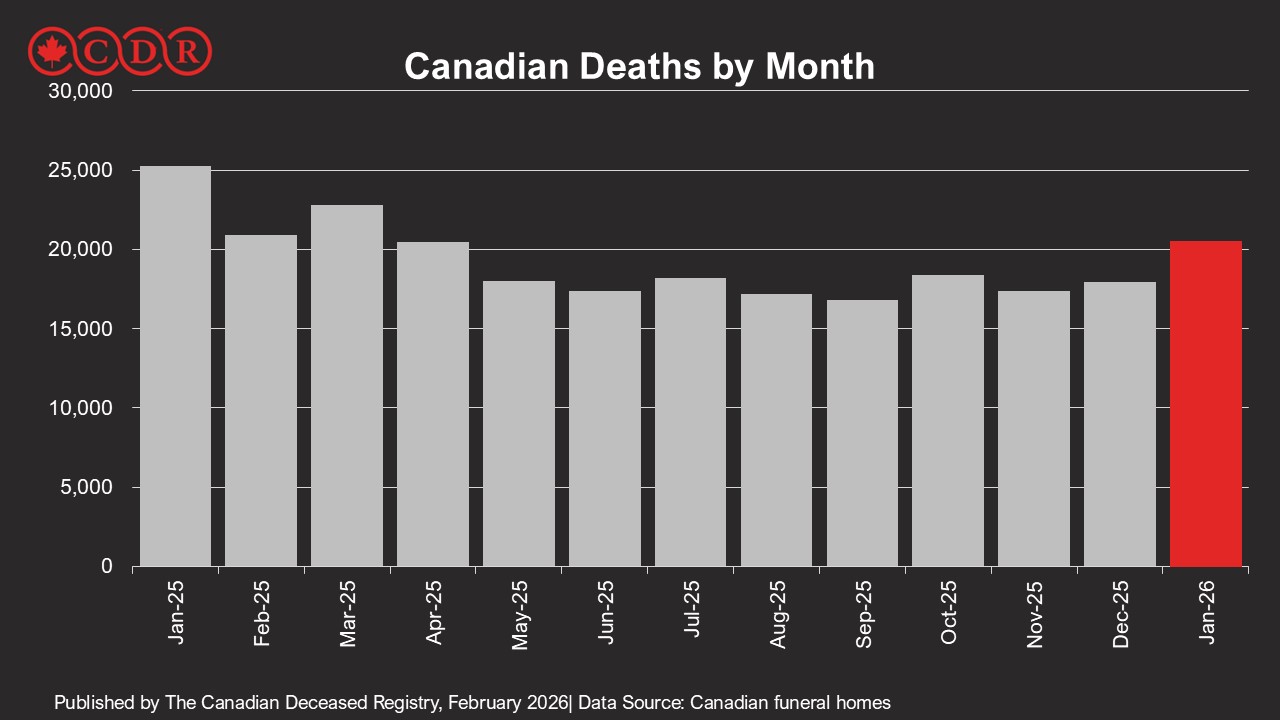
After reaching a year-end low in December, January mortality levels rebounded as expected.
📊 January 2026 Snapshot
In January 2026, the Canadian Deceased Registry identified 20,432 confirmed deaths nationwide.
That represents:
- ▲ 14% increase month-over-month (vs. December 2025: 17,966)
- ▼ 19% decrease year-over-year (vs. January 2025: 25,284)
This increase reflects a normal seasonal reset following December’s unusually low activity, not a reversal of the broader normalization trend observed throughout 2025.
Key Metrics (National)
- Total deaths: 20,432
- Deaths per 100K population: 50.6
- Average age at death: 79.4 years
Both the mortality rate and average age at death remain aligned with long-term historical patterns. January’s increase restores volumes closer to seasonal norms without signaling elevated systemic risk.
📍 Provincial Highlights
Mortality volume in January remained concentrated in Canada’s most populous provinces:
- Ontario: 8,252 deaths | 52.2 per 100K | Avg age 79.4
- Quebec: 5,264 deaths | 58.8 per 100K | Avg age 81.4
- British Columbia: 1,426 deaths | 25.6 per 100K | Avg age 80.4
- Alberta: 1,789 deaths | 37.6 per 100K | Avg age 77.8
Ontario and Quebec together accounted for roughly two-thirds of all recorded deaths nationwide, reinforcing where suppression, monitoring, and proof-of-life controls deliver the greatest operational impact.
Across most provinces, death rates increased modestly from December but remained well below the elevated levels seen in early 2024.
Why This Matters for Organizations
Lower year-over-year mortality does not reduce operational risk.
Even at normalized levels:
- Inappropriate outreach damages trust and brand equity
- Billing, collections, or benefits errors create compliance exposure
- Fraud risk increases when deceased identities remain active
- Data decay accelerates silently without continuous monitoring
Seasonal rebounds like January’s underscore why point-in-time cleans are insufficient.
The Takeaway
January’s data confirms a predictable seasonal pattern:
December marks the low point; January restores baseline mortality levels.
Organizations that rely on customer, donor, policyholder, or constituent data should:
- Continuously suppress deceased records
- Monitor databases in near real time
- Treat proof-of-life as an ongoing discipline, not a periodic task
Accuracy — not volume — is what ultimately determines risk.
About The Data
The data presented in this report was summarized by the Canadian Deceased Registry™, Canada’s only national registry of deceased Canadians. To learn more about the database, submit your inquiry using our contact web form.
Distribution of the Canadian Deceased Registry™ is managed by Cleanlist, Canada’s largest customer data company. Through Cleanlist, you can license the Canadian Deceased Registry™ database or access it to clean, validate, and enrich the data you have.
