
After four months of relatively stable mortality reporting, the Canadian Deceased Registry™ recorded a notable increase in October 2026.
A total of 18,884 deceased records were captured across Canada, compared with 17,056 in September.
The difference of 1,828 records represents a 10.7% month-over-month increase, bringing the national total to its highest level since January.
Unlike September, when provincial increases and decreases largely offset one another, October’s increase was widespread.
Every Canadian province recorded higher deceased counts, although Ontario and Quebec accounted for most of the national increase.
For organizations maintaining customer, member, donor, or constituent databases, October reinforces why deceased identification remains an important part of ongoing data management.
October Breaks Four Months of Relative Stability
From June through September, monthly deceased counts remained within a narrow range of approximately 16,900 to 17,400 records.
October brought a clear departure from that pattern.
Looking at the past 13 months provides a broader view of how reported mortality has changed.
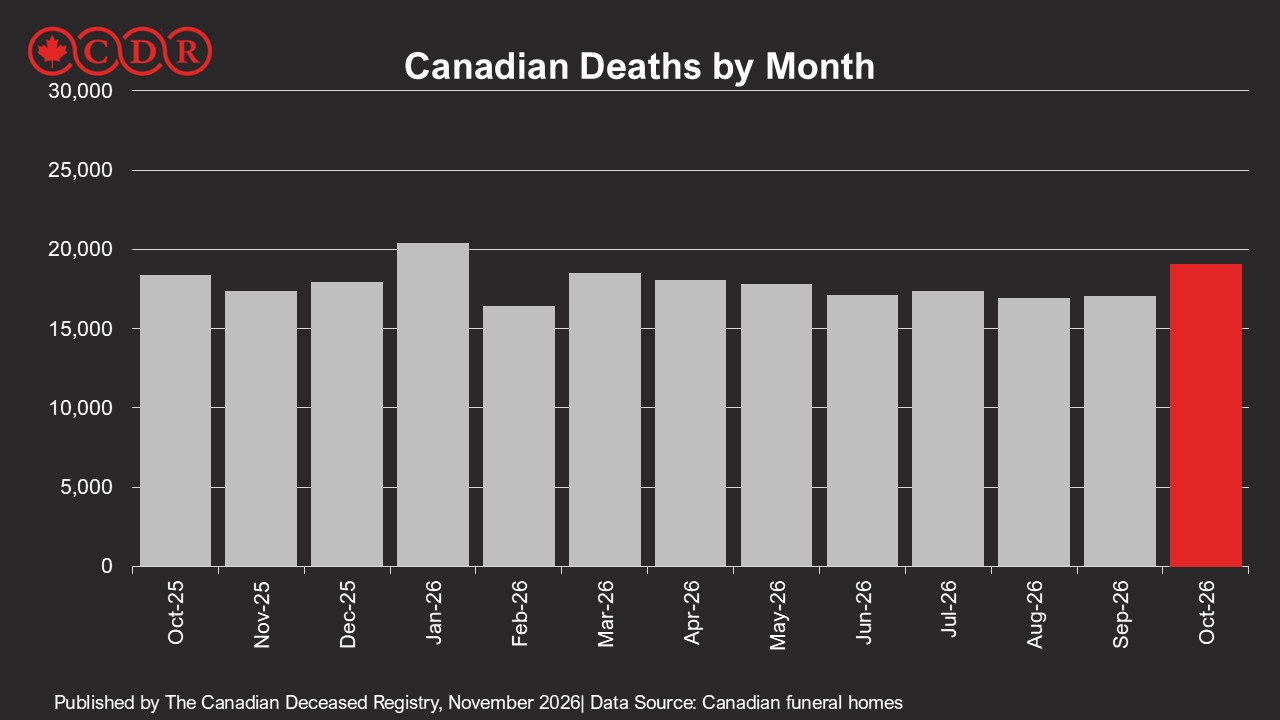
The trend shows higher volumes during parts of the fall and winter, followed by relatively lower counts through much of 2026.
January recorded 20,432 deceased records, the highest monthly total of 2026 so far.
After declining in February, monthly totals fluctuated before settling into a relatively consistent range throughout the summer.
October’s 18,884 records ended that four-month period of stability and brought reported mortality back above 18,000 for the first time since April.
Despite the increase, October remained approximately 7.6% below January’s peak.
The year-over-year comparison provides additional perspective.
October 2025 recorded 18,364 deceased records, meaning October 2026 was approximately 2.8% higher than the same month last year.
These comparisons suggest that October’s increase is notable within the recent monthly trend, although the longer-term data shows that similar and higher volumes have been recorded previously.
As with other Registry reporting, monthly figures reflect deceased records captured in the database and should not be interpreted as official mortality statistics or definitive evidence of changing mortality rates.
Ontario and Quebec Drive Most of the Increase
Although deceased counts increased across every province, the largest contributions came from Canada’s two biggest provincial markets.
October’s four largest provincial totals were:
- Ontario: 7,286 (+8.1% MoM)
- Quebec: 5,168 (+19.8% MoM)
- Alberta: 1,532 (+1.9% MoM)
- British Columbia: 1,466 (+7.3% MoM)
Ontario remained the largest contributor to the Canadian Deceased Registry™, accounting for approximately 39% of all records captured nationally.
Its monthly total increased by 547 records, from 6,739 in September to 7,286 in October.
Quebec recorded an even larger increase.
After declining in September, Quebec’s count rose from 4,313 to 5,168 in October, an increase of 855 records, or approximately 20%.
Together, Ontario and Quebec accounted for approximately 77% of the national month-over-month increase.
British Columbia also recorded a meaningful increase of approximately 7%, while Alberta experienced a more modest rise of nearly 2%.
These differences show that although October’s increase was nationwide, its magnitude varied considerably between provinces.
Every Province Recorded Higher Deceased Counts
October’s most distinctive feature was the consistency of its direction across Canada.
All ten provinces recorded increases, although the percentage changes varied.
The largest increases included:
- Quebec: +19.8%
- Newfoundland and Labrador: +19.2%
- Nova Scotia: +13.6%
- Manitoba: +12.2%
- Ontario: +8.1%
Other provinces also moved higher:
- British Columbia: +7.3%
- New Brunswick: +5.2%
- Saskatchewan: +3.3%
- Alberta: +1.9%
- Prince Edward Island: +1.7%
Newfoundland and Labrador and Nova Scotia recorded particularly noticeable percentage increases, although their smaller populations of Registry records mean their absolute contributions to the national total were more limited.
Ontario and Quebec, by contrast, had the greatest influence on the national increase because of their substantially larger record volumes.
The result was a broad-based increase rather than one driven exclusively by a single province.
For organizations maintaining geographically distributed customer or constituent databases, this reinforces the importance of maintaining deceased screening coverage across all relevant regions.
Why Higher Deceased Counts Matter for Database Management
October’s increase highlights an ongoing challenge for organizations managing large consumer databases.
Every newly identified deceased record may correspond to an individual who remains within an active customer, prospect, donor, member, or account database.
Even during months when mortality reporting is relatively stable, these changes accumulate.
From June through October 2026, the Canadian Deceased Registry™ captured 87,401 deceased records nationwide.
Without regular screening and updates, outdated records may remain active and contribute to:
- Inappropriate customer or marketing communications
- Returned or unnecessary mail
- Continued servicing of outdated records
- Increased exposure to identity fraud
- Inaccurate customer and constituent information
- Additional compliance and reputational risk
October’s increase does not necessarily mean organizations face a sudden change in risk.
Rather, it illustrates how quickly the number of potentially outdated records can grow when database maintenance is delayed.
For organizations managing hundreds of thousands or millions of individual records, regular deceased identification can help reduce these risks and support more responsible data practices.
Where Deceased Data Supports Better Database Management
Organizations across financial services, insurance, government, fundraising, loyalty programs, healthcare administration, and other sectors may maintain extensive databases of individual records.
At that scale, even a relatively small percentage of outdated information can affect operational efficiency, communications, and data accuracy.
Regularly screening records against a national Canada-wide mortality database of deceased Canadians who have passed away can help organizations identify deceased individuals and take appropriate action within their systems.
Depending on the organization and use case, deceased data can support:
- Fraud and identity-risk controls
- Database cleansing and suppression
- Compliance and account management processes
- Returned-mail reduction
- More accurate customer analytics
- Responsible customer and family communications
The value of deceased data extends beyond monitoring changes in reported mortality.
For many organizations, it serves as a practical tool for maintaining accurate records, reducing unnecessary outreach, and supporting better data governance.
Bottom Line
The Canadian Deceased Registry™ captured 18,884 deceased records in October 2026, a 10.7% increase from September and approximately 2.8% more than October 2025.
The increase ended four consecutive months of relatively stable reporting and brought the national total to its highest level since January.
Unlike September’s mixed provincial results, every Canadian province recorded an increase in October.
Ontario and Quebec accounted for most of the national rise, with Quebec experiencing the largest percentage increase among the major provincial markets.
For organizations maintaining large consumer databases, October provides another reminder that deceased information changes continuously.
Whether monthly mortality reporting rises, falls, or remains stable, regular deceased screening helps organizations keep their records accurate, current, and appropriate for ongoing use.
About The Data
The data presented in this report was summarized by the Canadian Deceased Registry™, Canada’s only national registry of deceased Canadians. To learn more about the database, submit your inquiry using our contact web form.
Distribution of the Canadian Deceased Registry™ is managed by Cleanlist, Canada’s largest customer data company. Through Cleanlist, you can license the Canadian Deceased Registry™ database or access it to clean, validate, and enrich the data you have.
